
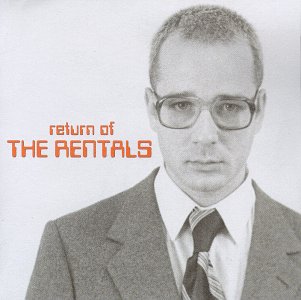
 The Basics: In 1995, original Weezer bassist Matt Sharp turned a small, low-budget side-project into a minor hit with "Friends of P"--a new wave-ish tribute to producer Ric Ocasek's supermodel wife Paulina Porizkova. The Return of the Rentals--a collaboration between Sharp and members of that dog. as well as Weezer bassist Pat Wilson--was picked up by Madonna's Maverick Records label and thanks to the success of "P," the band grew a life of its own. Though Sharp returned to Weezer for 1996's Pinkerton , he exited the group not long after (under what initially seemed to be friendly terms, but later--following a lawsuit levied by Sharp on Weezer--seemed vaguely not-so-friendly). He turned to The Rentals full time, releasing a sophomore effort, Seven More Minutes, in 1998.
Tell Me More: Born in 1969 in Bangkok, Thailand, Matt Sharp's family soon moved to Arlington, Virginia (assuming dad had some job with the government). Fed up with the classic rock-heavy music scene of his hometown, the punk-influenced Sharp made his way to California at the tender age of 16 and ended up in San Diego. After playing in various metal bands, Sharp met drummer Patrick Wilson. Wilson and Sharp drafted guitarist Jason Cropper to make up the band known as The Wrong Sausage. At the same time, Wilson was in a band called Fuzz with former metal guitarist gone alternative singer/songwriter Rivers Cuomo. Soon, Wilson convinced Cuomo to move into he and Sharp's apartment so they could take advantage of Cuomo's 8-track recorder.
In the summer of 1991, Sharp moved to Berkley, California to work on his own "symphonic keyboard sequencing" music, but by January, he had reconnected with Wilson, Cuomo and Cropper and by Valentine's Day of that year, the band known as "Weezer" was holding their first rehearsal.
After being signed to Geffen Records, the band hooked up with Cars frontman Ric Ocasek, who would produce their eponymous debut (widely nicknamed "The Blue Album"). With the surprise success of that album, Sharp spent the downtime from touring recording his own songs with members of Weezer and that dog.
Though originally intended as a personal project with no plans for release, record companies soon became interested, and the "band" (the lineup was never concrete) signed with Madonna's Maverick Records.
The First Single: To start, let's get this "Who is P?" nonsense out of the way. As rumored, the song is indeed about Ocasek's wife Paulina Porizkova. From a 1998 Addicted to Noise interview with Sharp:
"It was one of the first songs I'd ever written at the total infancy of all that stuff. I think at the time it came about because [Porizkova] had mentioned that the only people who would write songs for her were bad heavy-metal bands or something like that. And all her friends were getting these songs written about them and all these other supermodel girls were getting all these songs written about them. So it may have been kind of off-handed like that. That song was written when we were making the first Weezer record, when she was around quite a bit, very pregnant and very large."Okay, so now that that's through, let's talk about the rest of the song. A fuzzed out pop song using the aesthetics of new wave (notably Moog synthesizers) to create a lighthearted, upbeat composition far removed from the darker and more sinister synth-heavy new wave of the early '80s. While most new wave was concerned with adapting the concerns of 1984 and Brave New World--depersonalization and alienation caused by technology--into musical form, here Sharp uses the same aesthetics to make a fun, power-pop tribute to those soulless robotic songs made popular by bands like Tubeway Army. It'd almost seem like sacrilege to the synth-pop purists if it wasn't so damn catchy. The "big sound on a low budget" aesthetic makes it even more charming--there's all sorts of synths, violins and harmonies going on, but you can't get away from the feeling that this was made on some very dated analog equipment--like Depeche Mode with a 4-track. But the fact that it sounds like it was made for pennies is part of the beauty of it: at times, it sounds like the lost work of a garage band from the early '80s who was more concerned with writing theme songs for their Atari 2600 games than cynical notions of futuristic dystopias.
So as a one-hit wonder, was this just another novelty hit? Most likely. People forget that Weezer started out with not one but two novelty hits--"Buddy Holly" and "Undone - The Sweater Song," before getting some recognition for the heavy emotions of "Say It Ain't So." "Friends of P" offered another hit in line with "Buddy Holly," but even weirder and maybe not quite as friendly--though undoubtedly just as catchy. The song reached #7 on Modern Rock charts and just barely dented the Hot 100 at #92. The accompanying video's aesthetic was keeping in line with the music's--cheap, antiquated, static, weird and funny.
The Second Single: "Waiting" was an odd choice for a follow-up single. Used as a tie-in with MTV Films' first feature, the singing cockroach comedy Joe's Apartment, the song was given the big (and seriously, it looks huge) budget video treatment and made its debut on 120 Minutes (note Afro'd keyboardist and future SNL alum Maya Rudolph):
Personally, I think "My Summer Girl" would have been a more obvious follow-up single. It's not quite as fast as "Waiting," but it's twice as catchy. Regardless, The Rentals were probably destined to be a one-hit wonder. "Friends of P" was hung with the dreaded "novelty" tag early on, and as we've learned from a good 50% of the artists the blog has covered, that's almost as bad as not having anything good to follow it up with. It's almost more infuriating that audiences rejected follow-ups that were just as good if not better, simply because they'd decided the novelty had worn off. It's a shame really, cause, in a just world, most of the songs on Return of the Rentals could have been released as singles. But as any power-pop act from Fountains of Wayne and Matthew Sweet to Cheap Trick and Big Star will tell you: simply having catchy, well-written songs doesn't mean shit in this day and age.
"Waiting" failed to chart and wasn't included in heavy-rotation on MTV.
Whatever Happened to...?: In the ensuing years since the release of Return of the Rentals, a myriad of odd things have happened concerning Sharp/The Rentals.
1999: First, Sharp and Weezer parted ways sometime after Pinkerton. Whether he was fired or left is still unclear (Sharp claims he never left or quit). Then, The Rentals made a big, gorgeous, Brit-pop influenced follow-up album called Seven More Minutes, released by Maverick in 1998. The album featured appearances by Blur's Damon Albarn, Ash's Tim Wheeler, Elastica's Donna Matthews, and a song co-written by former Weezer band mate Rivers Cuomo. Despite being completely commercial and pop-oriented, the album tanked. There were a myriad of factors going against the album--the changing tide of rock music, the failure of Weezer's Pinkerton, the fact that SMM sounded a lot different than ROTR. While not an entirely different sound from their debut, the group took it in a whole new direction, no doubt disappointing or confusing fans of the first album who wanted more of the same. I still know people who love ROTR and hate SMM or vice versa. It's quite literally two different bands. Following the failure of the album, Sharp exited the limelight without a word--some assumed for good...
 2000: But it wasn't for good. After the success of Weezer's comeback album Weezer (2000) aka the Green Album, people were suddenly interested in Matt Sharp again. The reasons were numerous, but the number one reason was this: Weezer didn't sound like Weezer anymore, and many assumed that was due to Sharp's absense. Despite the fact that Sharp had no songwriting credits on either album, fans posited that he must have had some creative influence over the band that was irretrievably lost upon his exit (more on this later). And with the release of 2002's Maladroit--another disappointment to longtime fans--the theory picked up steam. Sharp quickly became considered something of a martyr by Weezer fandom--a secret genius who had refused to be relegated to the role of sideman by a tyrannical frontman, and Sharp's silence only helped this legend grow. So when Sharp finally broke his silence, people--or at least, hardcore Weezer fans--took notice.
2002: Word began to leak that Sharp had decamped to rural Leiper's Fork, Tennessee (about an hour outside of Nashville) to pursue a solo project. The music was reported to be more stripped down and folky--most songs consisting of Sharp and his acoustic guitar, with maybe some organ here and there. At the same time, Sharp became the subject of controversy when he filed a federal lawsuit against Weezer alleging he was owed royalties for co-writing the hit "Undone (The Sweater Song)" and "owned a 25% interest in the first nine tracks of Pinkerton," all of which were credited solely to Rivers Cuomo. He also charged them with a bunch of other legalese stuff--in the end, they settled out of court. Around the same time Sharp remarked that, despite his lawsuit, his influence was not that large, and the new albums would be just as bad if he were still with the group (noting he hadn't heard the new albums).
Around this time Cuomo himself had taken to chat rooms and message boards to interact with fans. When asked why he never released Weezer's proposed space opera Songs from the Black Hole (written after the Blue album, before Pinkerton), he answered simply "ROTR" (Return of the Rentals). Geeky fans (such as myself) deduced that Sharp may have been influenced by the new wave influenced/moog heavy demos Cuomo had recorded for Black Hole. Listening to the demos available on Cuomo's ALONE collections (as well as B-sides culled from the sessions), there are some sonic and aesthetic similarities, but nothing to implicate Sharp in any sort of creative thievery.
Others have speculated that Sharp was not in fact ripping off Cuomo's ideas, but rather was working in collaboration with him on Black Hole and decided to use the songs for his own project instead. Since Return of the Rentals would be released before the next Weezer album, the incenuation was that Cuomo did not want to be accused of ripping off The Rentals. Parts of Black Hole ("Tired of Sex," for instance) ended up on Pinkerton. All in all, what you really need to know is that Weezer has some of the geekiest fans around (yours truly included).
2004: In 2003, Sharp released a solo EP Puckett's vs. The Country Boy, and a year later released a self-titled full length. Both albums were culled from the sessions in Leiper's Fork. Around this time, Sharp began doing acoustic solo tours and, to everyone's surprise, on February 12, 2004 (two days before the 12th anniversary of Weezer) Cuomo joined Sharp on stage at UCal - Fullerton where they played a couple of joint compositions from back in the day. The performance lead to rumors of a Sharp and Cuomo collaboration which never came to fruition due to what Sharp describes as the duo's "special brand of dysfunction." However, by this time the lawsuit had been settled out of court and there was brief talk of Sharp re-joining Weezer as a third guitar player--however, this did not come to fruition.
2005-present: Instead, Sharp went back to The Rentals, where he has been steadily working for the past four years with a (mostly) all new group of musicians. In 2007, the group released an EP, The Last Little Life and toured during 2006-2007. At the moment, the band is preparing to release Songs About Time, described as "three mini-albums to be released in April, July, and October as digital downloads. At the end of the year, the band will release a limited deluxe edition box set of the project, available both as compact discs and 180-gram vinyl records." Note to Sharp: Sounds complicated. Just give me a new CD, guy.
Based on the new songs on the group's MySpace page, the sound is sort of a combination of Seven More Minutes, Return of the Rentals and a surprising amount of influence from Sharp's solo acoustic work--the sound is far more organic than the fuzzed out futuristic sound of the band's albums. All in all, the new songs are essential for any old-school Weezer or Rentals fan--while I can't say I'm too eager for the next hopelessly ironic new Weezer album, Ratitude, Sharp still seems like a serious artist who's ready to make some cool music.
Download: The Rentals - Friends of P
Download: The Rentals - Waiting
Download: Matt Sharp & Maya Rudolph - Not Tonight (Tegan & Sara cover)


 Posts
Posts


